The human trace.
English
I cannot say exactly when my interest in architecture began. I know that, long before I thought of it as a profession, I was drawn to the things people make: how they take shape, the marks they retain, the stories they seem to hold. Perhaps I inherited something of this sensibility from my mother. It is certainly a curiosity that has stayed with me throughout my life.
I often find myself looking at an object and imagining everything that happened before it reached me. An initial idea, a decision, a hand trying something out, a mistake corrected, a technique learned from someone else. It matters little to me whether the object is considered important or ordinary. It might be a painting, a page of writing, a piece of furniture, a mechanism or a working tool. What interests me is the human presence behind its form.
I am not drawn only to things that are beautiful in the most obvious sense. I am interested in imperfect objects too: things that have been used, travelled, passed from one person to another. A surface marked by time can reveal more than a flawless one. There is dignity in human skill, even in the simplest trade, that has nothing to do with the prestige of what is made.
This is why art and craftsmanship, literature, design and the more everyday expressions of material culture do not seem separate worlds to me. Each, in its own way, speaks of the same impulse: to give form to ideas, to needs and sometimes to dreams. And through that form, to leave a small trace of one's existence.
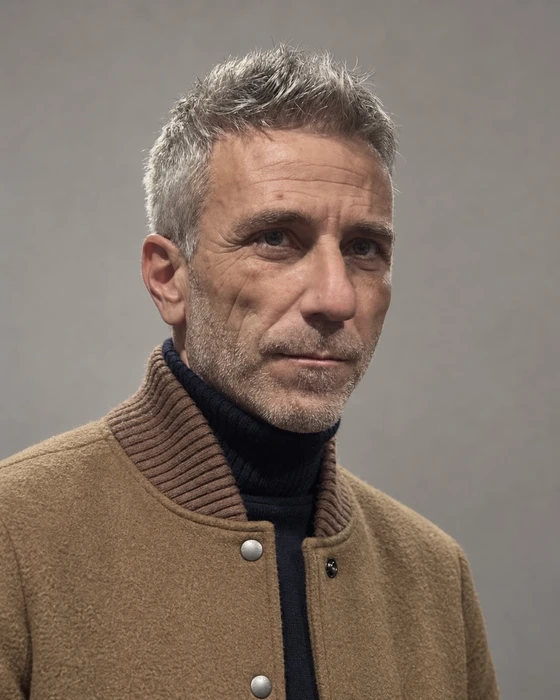
I believe this way of looking at things has deeply shaped my work as an architect. I established my practice in 2006, after graduating from the Politecnico di Milano, but I do not see design as something that begins with a blank sheet of paper. Every place already holds something: a history, a balance, a sense of scale, sometimes a wound. Before deciding what to add, I feel the need to understand what is there.
When working with an existing building, I try to recognise its qualities without idealising it. Not everything from the past should be preserved, and not every change is an improvement. Often the hardest part of a project is knowing where to intervene and where to stop.
The restoration of Casa AF brought that responsibility into particularly sharp focus. I knew Giuseppe Galimberti personally. He had designed the house in 1974, and I had come to appreciate his architectural thinking. It seemed essential to respect the character of his work, recognising that even relatively recent architecture can deserve a deeply considered approach to conservation.
In other projects, what already exists suggests a more visible transformation. A rural building, an element associated with a particular trade, or an apparently ordinary structure can provide the starting point for something new. To me, tradition is not a collection of forms to repeat, but a body of knowledge from which we can continue to learn.
Even when designing a new building, I look for a relationship with its surroundings. That does not necessarily mean making the architecture disappear. It means finding a presence that responds to the landscape, the city and the lives unfolding there. I care about proportions, about allowing materials to express their character, and about treating light as more than a visual effect.
I have great respect for people who know how to make things. The work of a carpenter, a metalworker, or anyone with a deep understanding of a material reminds me that architecture is not just an idea. It must become something real, made with intelligence and care. A well-resolved detail bears witness to that meeting of thought and work.
And then there are the people who will live with the result. That is the part no drawing or photograph can fully tell. A house becomes a home, an office is occupied day after day, a place to stay becomes someone's memory. I like to think architecture should make room for those lives rather than try to control them. A space should be able to accommodate the possessions, habits and changes of the people who use it.
Over the years, a sense of restraint has become increasingly important to me. Not adding something simply because it can be added. Not searching for a recognisable gesture at any cost. Sometimes the most convincing decision is to let a material, a proportion or an existing trace speak for itself.
‘History producing contemporaneity’ sums up this attitude towards design. It is neither a wish to return to the past nor an urge to transform everything we encounter. It is the belief that we can shape the present more thoughtfully when we understand what came before it.
In the end, I think my passion has remained the same. I keep looking, in very different things, for that moment when material becomes more than material: when it bears witness to a life, a thought, a human gesture. Architecture is how I have found a way to take part in that story.